Table of Links
- I. Abstract and Introduction
- II. Related Work
- III. Modeling of Mobile Channels
- IV. Channel Discretization
- V. Channel Interpolation and Extrapolation
- VI. Numerical Evaluations
- VII. Conclusions, Appendix, and References
VII. CONCLUSIONS
In this paper, we talked about the advantages of OTFS over OFDM in terms of spectral efficiency, resulting from the much reduced channel training overhead. We showed that the D-D domain channel model is also an approximation of the real channel, but it is more accurate then the LTI model, and thus allows us to estimate the channel with a much reduced channel estimation frequency. The predictability of the channel in T-F domain comes from the sparsity of response in D-D domain. Besides, we showed that it’s possible to use a very small amount of resources for channel interpolation. A pipeline algorithm is proposed for channel interpolation with reduced processing delay. Further more, we showed that channel extrapolation and data-aided channel tracking would be possible, benefiting from the predictability of the D-D domain channel. Two sources of channel interpolation error are unveiled: the D-D domain aliasing resulting from the finite TF window, and the ISCI induced by channel dispersion. Their impacts on channel estimation error are quantified. Overall, we can conclude that OTFS has a huge advantage over OFDM due to the reduced channel training overhead. As a matter of fact, this advantage actually comes from the D-D domain channel model itself, and is thus shared by other signaling techniques designed for doubly-dispersive channels.
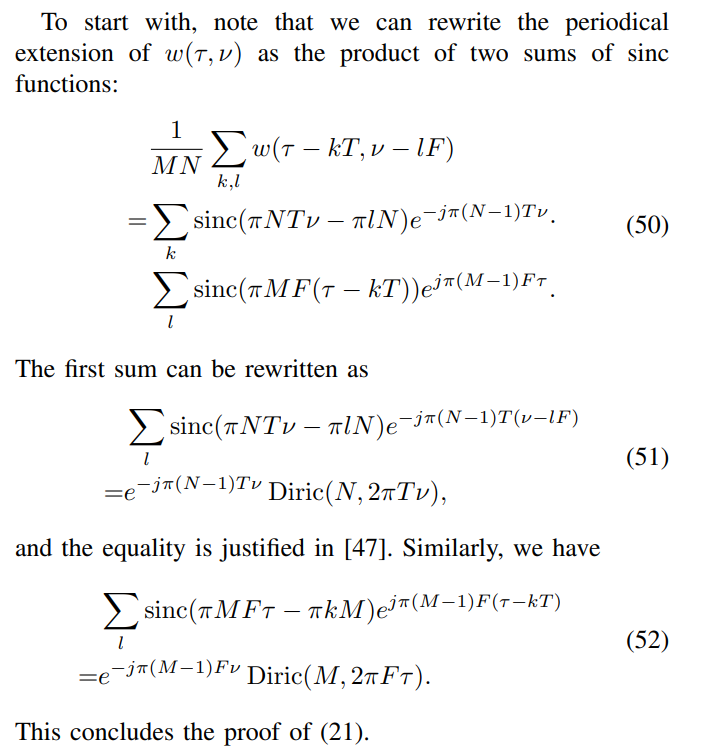
APPENDIX A SUM OF sinc AND DIRICHLET FUNCTIONS
REFERENCES
[1] S. B. Weinstein, “The history of orthogonal frequency-division multiplexing [history of communications],” IEEE Commun. Mag., vol. 47, pp. 26–35, Nov. 2009.
[2] R. W. Chang, “Synthesis of band-limited orthogonal signals for multichannel data transmission,” The Bell Sys. Tech. J., vol. 45, pp. 1775– 1796, Dec. 1966.
[3] L. Cimini, “Analysis and simulation of a digital mobile channel using orthogonal frequency division multiplexing,” IEEE Trans. Commun., vol. 33, pp. 665–675, July 1985.
[4] D. Tse and P. Viswanath, Fundamentals of Wireless Communication. Cambridge University Press, 2005.
[5] T. L. Marzetta, “Noncooperative cellular wireless with unlimited numbers of base station antennas,” IEEE Trans. Wireless Commun., vol. 9, pp. 3590–3600, Nov. 2010.
[6] Y. Song, Z. Gong, C. Li, and Y. Chen, “Efficient channel estimation for wideband millimeter wave massive MIMO systems with beam squint,” IEEE Trans. Commun., vol. 70, pp. 3421–3435, May 2022.
[7] Z. Gong, C. Li, and F. Jiang, “Pilot decontamination in noncooperative massive MIMO cellular networks based on spatial filtering,” IEEE Trans. Wireless Commun., vol. 18, pp. 1419–1433, Feb. 2019.
[8] E. Dahlman, S. Parkvall, and J. Skold, 5G NR: The next generation wireless access technology. Academic Press, 2020.
[9] T. Dean, M. Chowdhury, and A. Goldsmith, “A new modulation technique for Doppler compensation in frequency-dispersive channels,” in 2017 IEEE 28th Annual International Symposium on Personal, Indoor, and Mobile Radio Communications (PIMRC), pp. 1–7, 2017.
[10] T. R. Dean, M. Chowdhury, N. Grimwood, and A. J. Goldsmith, “Rethinking modulation and detection for high Doppler channels,” IEEE Trans. on Wireless Commun., vol. 19, pp. 3629–3642, June 2020.
[11] T. Wang, J. Proakis, E. Masry, and J. Zeidler, “Performance degradation of OFDM systems due to Doppler spreading,” IEEE Trans. on Wireless Commun., vol. 5, pp. 1422–1432, June 2006.
[12] A. Monk, R. Hadani, M. Tsatsanis, and S. Rakib, “OTFS-orthogonal time frequency space,” 2016. arXiv preprint arXiv:1608.02993, Aug. 2016.
[13] R. Hadani, S. Rakib, M. Tsatsanis, A. Monk, A. J. Goldsmith, A. F. Molisch, and R. Calderbank, “Orthogonal time frequency space modulation,” in 2017 IEEE Wireless Communications and Networking Conference (WCNC), pp. 1–6, 2017.
[14] R. Hadani and A. Monk, “OTFS: A new generation of modulation addressing the challenges of 5G.” Available at https://arxiv.org/abs/1802. 02623, 2018. arXiv:1802.02623 [cs.IT].
[15] A. Bemani, N. Ksairi, and M. Kountouris, “Affine frequency division multiplexing for next generation wireless communications,” IEEE Trans. Wireless Commun., vol. 22, pp. 8214–8229, Nov. 2023.
[16] X. Ouyang and J. Zhao, “Orthogonal chirp division multiplexing,” IEEE Trans. Commun., vol. 64, pp. 3946–3957, Sept. 2016.
[17] M. S. Omar and X. Ma, “Performance analysis of OCDM for wireless communications,” IEEE Trans. Wireless Commun., vol. 20, pp. 4032– 4043, July 2021.
[18] H. Lin and J. Yuan, “Orthogonal delay-doppler division multiplexing modulation,” IEEE Trans. Wireless Commun., vol. 21, pp. 11024–11037, Dec. 2022.
[19] M. K. Ramachandran, G. D. Surabhi, and A. Chockalingam, “OTFS: A new modulation scheme for high-mobility use cases,” Journal of the Indian Institute of Science, vol. 100, pp. 315 – 336, April 2020.
[20] H. B. Mishra, P. Singh, A. K. Prasad, and R. Budhiraja, “OTFS channel estimation and data detection designs with superimposed pilots,” IEEE Trans. on Wireless Commun., vol. 21, pp. 2258–2274, Sept. 2022.
[21] P. Raviteja, K. T. Phan, and Y. Hong, “Embedded pilot-aided channel estimation for OTFS in delay-Doppler channels,” IEEE Trans. Veh. Technol., vol. 68, pp. 4906–4917, May 2019.
[22] R. Hadani, S. Rakib, A. F. Molisch, C. Ibars, A. Monk, M. Tsatsanis, J. Delfeld, A. Goldsmith, and R. Calderbank, “Orthogonal time frequency space (OTFS) modulation for millimeter-wave communications systems,” in 2017 IEEE MTT-S International Microwave Symposium (IMS), pp. 681–683, 2017.
[23] R. Hadani, S. Rakib, S. Kons, M. Tsatsanis, A. Monk, C. Ibars, J. Delfeld, Y. Hebron, A. J. Goldsmith, A. F. Molisch, and A. R. Calderbank, “Orthogonal time frequency space modulation,” CoRR, vol. abs/1808.00519, 2018.
[24] X.-G. Xia, “Comments on “the transmitted signals of OTFS and VOFDM are the same”,” IEEE Trans. on Wireless Commun., vol. 21, pp. 11252–11252, Dec. 2022.
[25] X.-G. Xia, “Precoded and vector OFDM robust to channel spectral nulls and with reduced cyclic prefix length in single transmit antenna systems,” IEEE Trans. Commun., vol. 49, pp. 1363–1374, Aug. 2001.
[26] P. Raviteja, E. Viterbo, and Y. Hong, “OTFS performance on static multipath channels,” IEEE Wireless Commun. Lett., vol. 8, pp. 745–748, June 2019.
[27] A. Sayeed and B. Aazhang, “Joint multipath-Doppler diversity in mobile wireless communications,” IEEE Trans. Commun., vol. 47, pp. 123–132, Jan. 1999.
[28] X. Ma and G. Giannakis, “Maximum-diversity transmissions over doubly selective wireless channels,” IEEE Trans. Inf. Theory, vol. 49, pp. 1832–1840, July 2003.
[29] Y. Ma, G. Ma, B. Ai, D. Fei, N. Wang, Z. Zhong, and J. Yuan, “Characteristics of channel spreading function and performance of OTFS in high-speed railway,” IEEE Trans. on Wireless Commun., vol. 22, pp. 7038–7054, Oct. 2023.
[30] G. D. Surabhi, R. M. Augustine, and A. Chockalingam, “On the diversity of uncoded OTFS modulation in doubly-dispersive channels,” IEEE Trans. on Wireless Commun., vol. 18, pp. 3049–3063, June 2019.
[31] R. M. Augustine, G. D. Surabhi, and A. Chockalingam, “Space-time coded OTFS modulation in high-Doppler channels,” in 2019 IEEE 89th Vehicular Technology Conference (VTC2019-Spring), pp. 1–6, 2019.
[32] S. K. Mohammed, R. Hadani, A. Chockalingam, and R. Calderbank, “OTFS-a mathematical foundation for communication and radar sensing in the delay-Doppler domain,” IEEE BITS the Information Theory Magazine, vol. 2, pp. 36–55, Nov. 2022.
[33] S. K. Mohammed, R. Hadani, A. Chockalingam, and R. Calderbank, “OTFS-predictability in the delay-Doppler domain and its value to communication and radar sensing.” arXiv:2302.08705 [eess.SP], Feb. 2023.
[34] W. Shen, L. Dai, J. An, P. Fan, and R. W. Heath, “Channel estimation for orthogonal time frequency space (OTFS) massive MIMO,” IEEE Trans. Signal Process., vol. 67, pp. 4204–4217, Aug. 2019.
[35] W. Shen, L. Dai, S. Han, I. Chih-Lin, and R. W. Heath, “Channel estimation for orthogonal time frequency space (OTFS) massive MIMO,” in ICC 2019 - 2019 IEEE International Conference on Communications (ICC), (Shanghai, China), pp. 1–6, 2019.
[36] D. Shi, W. Wang, L. You, X. Song, Y. Hong, X. Gao, and G. Fettweis, “Deterministic pilot design and channel estimation for downlink massive MIMO-OTFS systems in presence of the fractional Doppler,” IEEE Trans. on Wireless Commun., vol. 20, pp. 7151–7165, Nov. 2021.
[37] Y. Liu, S. Zhang, F. Gao, J. Ma, and X. Wang, “Uplink-aided high mobility downlink channel estimation over massive MIMO-OTFS system,” IEEE J. Sel. Areas Commun., vol. 38, pp. 1994–2009, Sept. 2020.
[38] M. Kollengode Ramachandran and A. Chockalingam, “MIMO-OTFS in high-Doppler fading channels: Signal detection and channel estimation,” in 2018 IEEE Global Communications Conference (GLOBECOM), pp. 206–212, 2018.
[39] L. Gaudio, G. Caire, and G. Colavolpe, “On achievable rate of OFDM and OTFS in the presence of sparsity,” in 2021 IEEE International Conference on Communications Workshops (ICC Workshops), (Montreal, QC, Canada), pp. 1–6, June 2021.
[40] L. Gaudio, G. Colavolpe, and G. Caire, “OTFS vs. OFDM in the presence of sparsity: A fair comparison,” IEEE Trans. on Wireless Commun., vol. 21, pp. 4410–4423, June 2022.
[41] S. K. Mohammed, “Derivation of OTFS modulation from first principles,” IEEE Trans. Veh. Technol., vol. 70, pp. 7619–7636, Aug. 2021.
[42] S. K. Mohammed, “Time-domain to delay-Doppler domain conversion of OTFS signals in very high mobility scenarios,” IEEE Trans. Veh. Technol., vol. 70, pp. 6178–6183, June 2021.
[43] P. Bello, “Characterization of randomly time-variant linear channels,” IEEE Trans. Commun. Sys., vol. 11, pp. 360–393, Dec. 1963.
[44] Z. Gong, F. Jiang, C. Li, and X. Shen, “Simultaneous localization and communications with massive MIMO-OTFS,” IEEE J. Sel. Areas Commun., vol. 41, pp. 3908–3924, Dec. 2023.
[45] K. Liu, T. Kadous, and A. Sayeed, “Orthogonal time-frequency signaling over doubly dispersive channels,” IEEE Trans. Inf. Theory, vol. 50, pp. 2583–2603, Nov. 2004.
[46] K. Grochenig, “Foundations of time-frequency analysis,” in ¨ Applied and Numerical Harmonic Analysis, 2000. [47] Z. Gong, “Fast signal interpolation through zero-padding and FFT/IFFT.” arXiv:2407.06502 [eess.SP], 2024.
Authors:
(1) Zijun Gong, Member, IEEE;
(2) Fan Jiang, Member, IEEE;
(3) Yuhui Song, Student Member, IEEE;
(4) Cheng Li, Senior Member, IEEE;
(5) Xiaofeng Tao, Senior Member, IEEE.
This paper is available on arxiv under CC BY-NC-ND 4.0 license.